

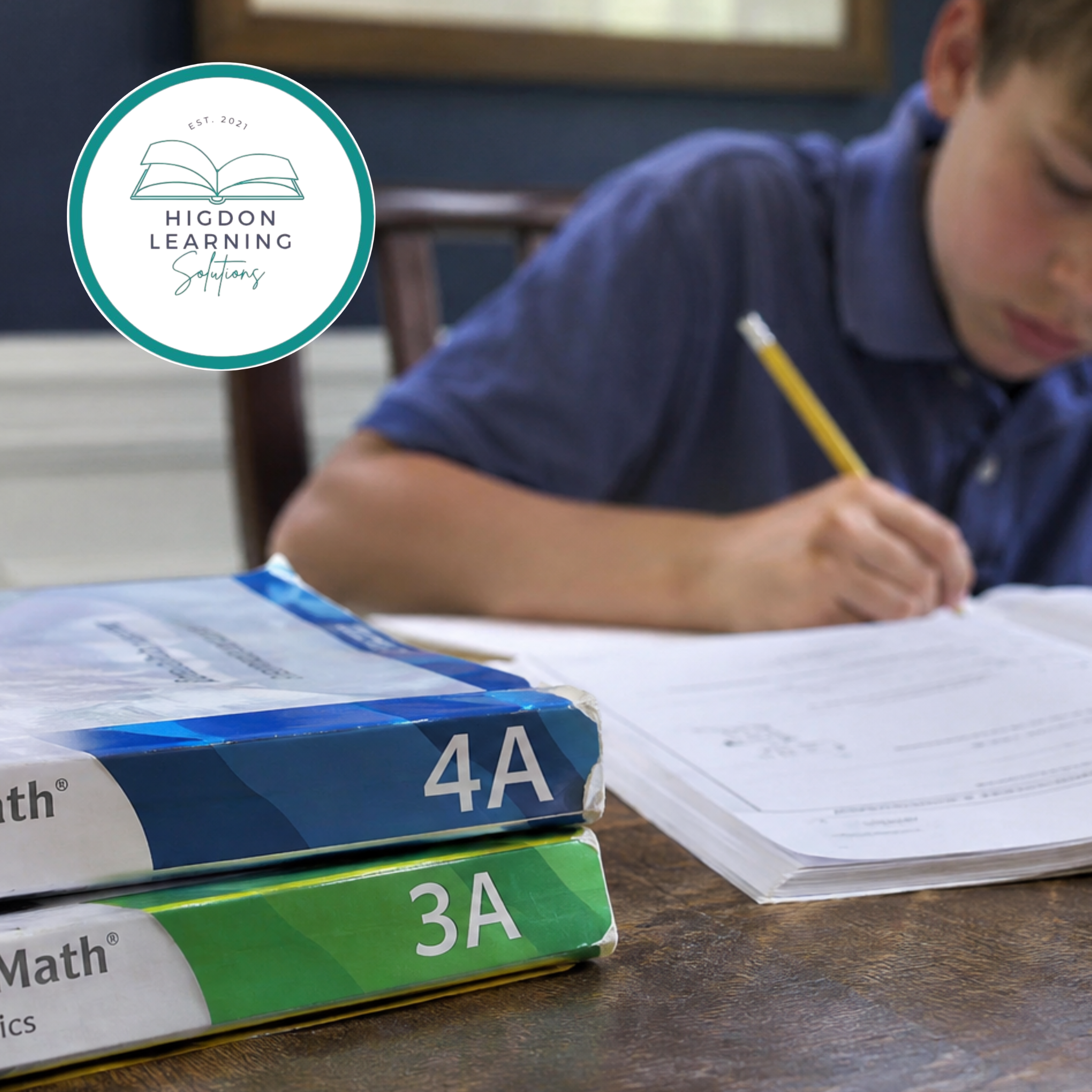
Singapore Math is an excellent curriculum. So why are so many bright, capable students suddenly struggling with it?
Over the past several weeks, we've seen a significant increase in inquiries from parents seeking Singapore Math intervention for their children, particularly students in third, fourth, and fifth grades.
The stories are remarkably similar.
"My child has always been good at math, but suddenly she's struggling."
"He understands it when the teacher explains it, but he can't do the homework independently."
"I'm trying to help, but I have no idea how they're teaching math this way."
And perhaps the most common: "My child is starting to hate math."
As someone who works extensively with students in classical schools, I want to explain what's happening, why Singapore Math can become particularly challenging in the upper elementary grades, and what parents can do about it.
First, Singapore Math Is Not the Problem
I want to be very clear about this: I am a strong supporter of Singapore Math.
When implemented well, it's an outstanding curriculum that develops mathematical reasoning, conceptual understanding, and problem-solving skills.
Unlike approaches that focus primarily on memorizing procedures, Singapore Math emphasizes understanding why mathematical operations work.
Its instructional framework follows a Concrete → Pictorial → Abstract (CPA) progression.
Students begin by manipulating physical objects, move to visual representations such as bar models, and eventually solve problems using numbers and mathematical symbols.
The goal is to develop students who don't simply know how to calculate an answer, but genuinely understand the mathematics behind it.
That's a worthy goal, and one that fits beautifully within classical education.
But a rigorous curriculum requires a strong foundation.
And that's where we frequently encounter difficulties.
1. Third and Fourth Grade Are Often Turning Points
One of the most common patterns we see involves students who performed well in kindergarten, first, and second grade but begin struggling in third or fourth.
This isn't particularly surprising.
As students advance through Singapore Math, the expectations increase significantly.
They're no longer simply adding and subtracting small numbers or solving straightforward multiplication problems.
They're expected to apply those skills to increasingly complex situations, including multistep word problems, fractions, division, and bar modeling.
A student might understand multiplication perfectly well when presented with a straightforward equation.
But ask that same student to read a paragraph, identify the relevant information, construct a bar model, select the appropriate operations, and explain the reasoning?
That's an entirely different level of mathematical demand.
The difficulty isn't necessarily that the student doesn't understand math. It's that several mathematical skills must now work together simultaneously.
Small weaknesses that previously went unnoticed can suddenly become significant obstacles.
2. Math Fact Automaticity Matters More Than Parents Realize
This is one of the first things we investigate when a student begins intervention.
Can the child recall basic addition, subtraction, multiplication, and division facts efficiently?
Not eventually. Not by counting on fingers or repeatedly calculating.
Can the student retrieve those facts with reasonable speed and accuracy?
Singapore Math places considerable emphasis on conceptual understanding, as it should. But conceptual understanding and fact automaticity are not competing goals.
They're complementary.
Consider a fourth grader solving a multistep fraction problem.
The student must understand the relationship between the numerator and denominator, interpret the word problem, construct a visual model, and perform several calculations.
If that child must devote substantial mental effort to figuring out 6 × 7 or 48 ÷ 8, fewer cognitive resources remain available for the more demanding reasoning.
The result?
A student who understands the concept may still struggle to complete the problem accurately or independently.
Automaticity frees students to focus on higher-level mathematical thinking.
This is why we often incorporate targeted fact practice into our Singapore Math intervention sessions, even when the student's primary difficulty appears to involve more advanced concepts.
3. Bar Modeling Is Powerful, but It Requires Explicit Instruction
Bar modeling is one of the most distinctive and valuable features of Singapore Math.
Rather than simply searching for numbers and deciding whether to add, subtract, multiply, or divide, students learn to represent mathematical relationships visually.
This is particularly effective for comparison problems, fractions, and multistep word problems.
However, constructing an appropriate bar model is a skill that must be developed.
Students need to understand:
What does the entire bar represent?
Which quantities are known?
Which quantity is unknown?
Are we comparing two amounts or identifying parts of a whole?
How should the sections be divided and labeled?
Which operations will help us solve the problem?
Some students can successfully complete a model when their teacher guides them through the process but struggle to construct one independently.
Others draw a model that looks correct without fully understanding the relationships it represents.
And some become so focused on drawing the model that they lose sight of the actual mathematical question.
These difficulties don't mean bar modeling is ineffective.
They mean the student may need more explicit instruction, guided practice, and opportunities to explain the reasoning behind the representation.
A bar model should clarify the mathematics, not become another obstacle to understanding it.
4. Parents Often Can't Help, Even When They're Excellent at Math
This is an especially common source of frustration.
Many parents are perfectly capable of solving their child's math problems.
What they don't necessarily know is how to teach the problems using the methods their child's school expects.
A parent might look at a Singapore Math word problem, identify the correct equation, and arrive at the answer in seconds.
But the assignment may require the student to construct a comparison bar model and demonstrate the relationship visually.
The parent says, "Why don't you just do it this way?"
The child responds, "That's not how my teacher showed us!"
And suddenly, homework becomes a battle.
Neither person is necessarily wrong.
The parent may be using a mathematically valid method, while the student is being asked to demonstrate a particular problem-solving strategy.
But introducing multiple unfamiliar approaches can create additional confusion for a child who is already struggling.
This is one reason curriculum-specific intervention matters so much.
A tutor who understands Singapore Math can reinforce the instructional approach used in the classroom rather than introducing competing methods before the student has mastered the original concepts.
At Higdon Learning Solutions, our goal is never to replace or undermine the curriculum a school has chosen.
It's to help students succeed within it.
5. Sometimes the Real Problem Started Years Earlier
A child who struggles with fourth-grade fractions may actually have a second-grade place-value weakness.
A student who cannot independently solve a multistep word problem may have difficulty interpreting mathematical language or identifying what a problem is asking.
A child who makes frequent computational mistakes may not have developed sufficient fluency with basic operations.
These difficulties are not always obvious in earlier grades.
Students may compensate by counting, memorizing procedures, imitating examples, or relying on teacher prompts.
But as the curriculum becomes increasingly demanding, those compensatory strategies become less effective.
This is why effective intervention begins with assessment, not simply more homework help.
When we work with a new student, we want to understand not only which problems are difficult, but why they're difficult.
We investigate foundational skills, mathematical reasoning, computational accuracy, and the student's ability to work independently.
Sometimes the solution involves revisiting an earlier concept.
Sometimes it requires more explicit instruction in bar modeling.
Sometimes the priority is multiplication and division fact fluency.
And frequently, it's a combination of several areas.
6. Struggling with Singapore Math Can Affect a Child's Confidence
Perhaps the most concerning pattern we see isn't mathematical at all.
It's emotional.
Students who previously enjoyed math begin describing themselves as "bad at math."
They become frustrated when homework takes longer than expected.
They hesitate to attempt unfamiliar problems.
They may rush, guess, shut down, or insist they don't know how to begin.
Over time, these experiences can influence how children perceive their own abilities.
That's especially unfortunate because many of these students are quite capable of succeeding with Singapore Math once the underlying difficulties are addressed.
Our goal is not simply to improve their accuracy.
It's to help them experience success, develop independence, and regain confidence in their mathematical abilities.
And that confidence comes from genuine mastery, not from making the work artificially easier.
What Should Parents Do?
If your child is beginning to struggle with Singapore Math, I encourage you to be proactive.
First, resist the temptation to assume the curriculum is simply too difficult or that your child isn't mathematically inclined.
Look more closely at the nature of the difficulty.
Does your child understand concepts during instruction but struggle to apply them independently?
Are basic math facts still slow or effortful?
Does your child understand a word problem but struggle to represent it visually?
Is homework taking an unreasonable amount of time?
Has your child become increasingly anxious or resistant when it's time to do math?
These observations can provide valuable clues about where support is needed.
Speak with your child's teacher to understand which skills are causing difficulty and how those concepts are being taught.
And when considering outside intervention, look for someone who is genuinely familiar with Singapore Math.
Knowing mathematics and knowing how to teach Singapore Math are not necessarily the same thing.
The Right Intervention Should Support the Curriculum, Not Compete With It
At Higdon Learning Solutions, we specialize in academic intervention for students in classical schools, including those using Singapore Math and Saxon Math.
We understand the importance of preserving the integrity of a school's chosen curriculum while giving individual students the instruction they need to succeed.
Our Singapore Math intervention uses the same Concrete → Pictorial → Abstract framework students encounter in their classrooms.
We emphasize foundational skill development, mathematical reasoning, bar modeling, computational fluency, and independent problem-solving.
Instruction begins with an assessment to identify the specific skills that require attention, followed by individualized, structured sessions designed to address those needs.
We work virtually with students across the country, allowing families outside the Washington, DC, area to access curriculum-specific intervention.
And although our sessions are virtual, they're not built around games or flashy educational software. We use direct instruction, interactive whiteboards, guided practice, and meaningful mathematical discussion.
The technology simply allows us to deliver individualized instruction wherever a student happens to live.
A Final Thought
The recent increase in Singapore Math intervention inquiries doesn't convince me that Singapore Math is failing students.
Quite the opposite.
It reminds me that a strong curriculum and effective individualized support must sometimes work hand in hand.
Singapore Math asks students to think deeply, reason carefully, and understand mathematical relationships.
Those are expectations worth preserving.
But when a student lacks the foundational skills necessary to meet those expectations, simply assigning more practice or telling the child to work harder isn't enough.
We need to identify what's missing and teach it explicitly.
Especially in third and fourth grade, timely intervention can make a meaningful difference before small gaps become larger obstacles.
At Higdon Learning Solutions, we believe that rigorous instruction and individualized support belong together.
We don't lower the bar. We give students the tools to reach it.
Is your child struggling with Singapore Math? Higdon Learning Solutions provides individualized, curriculum-specific math intervention for students in classical schools, both virtually nationwide and in person in select locations in the Georgetown, TX and Washington, DC, areas.
Learn more at www.higdonsolutions.com.
